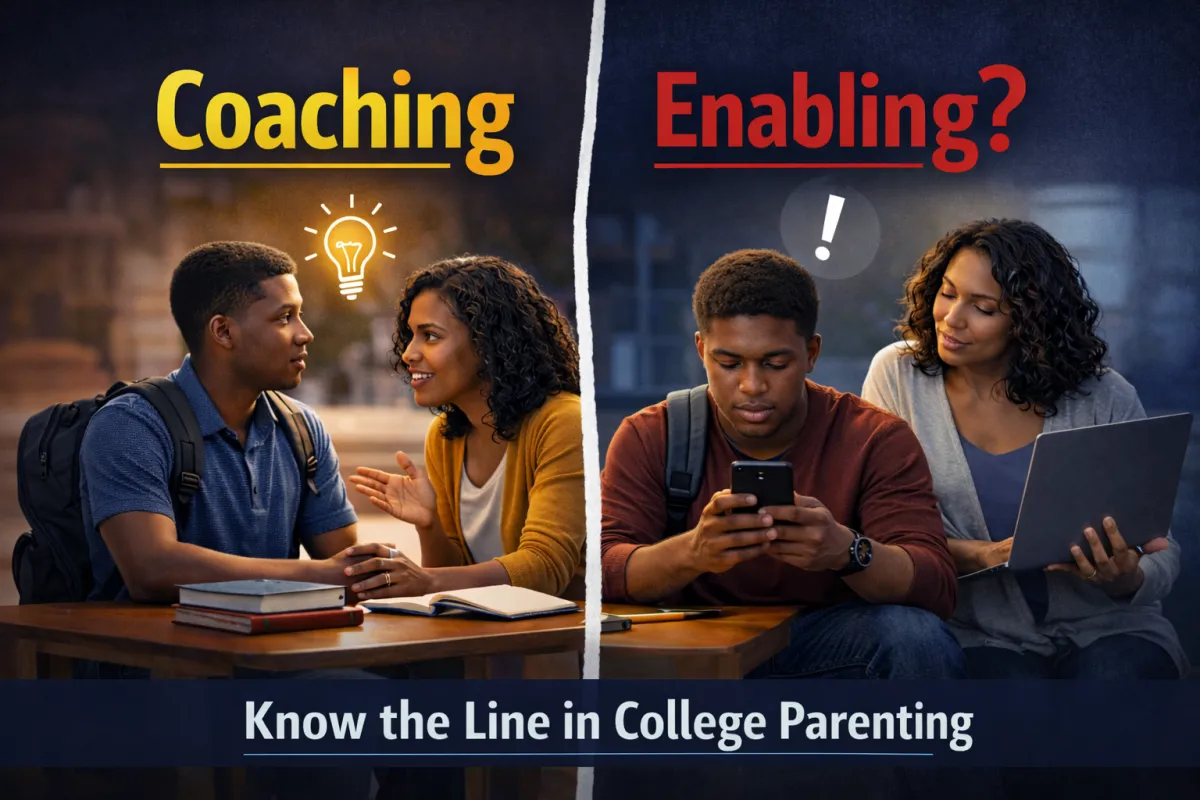
Coaching vs Enabling in Parenting College Students
When your child leaves for college, your role doesn’t disappear.
It evolves.
For many parents of college students, the line between supporting and saving becomes blurry. You want them to succeed. You want them to avoid pain. You want to protect the investment financially, emotional, and academic.
But here’s the uncomfortable truth:
Sometimes what feels like love… is actually enabling.
And enabling, even with good intentions, can quietly delay independence.
Let’s talk about the difference.
What Is Coaching in Parenting College Students?
Coaching is not controlling.
It’s not rescuing.
And it’s definitely not doing it for them.
Coaching is a partnership that builds capability.
In the context of parenting college students, coaching looks like:
Asking guiding questions instead of giving immediate solutions
Helping them reflect instead of reacting for them
Supporting problem-solving instead of removing every obstacle
Encouraging ownership of decisions and consequences
A coaching mindset says:
“I believe you are capable. Let’s think this through.”
Coaching builds:
Critical thinking
Emotional regulation
Decision-making skills
Confidence
Self-trust
And most importantly? It builds adult identity.
What Is Enabling?
Enabling often feels like being helpful.
But it removes growth opportunities.
Enabling can look like:
Emailing a professor about your student’s grade
Managing their calendar from home
Solving roommate conflicts for them
Sending emergency money repeatedly without financial conversations
Making career decisions because “they don’t know yet”
The message behind enabling is subtle but powerful:
“You can’t handle this without me.”
Over time, that message weakens resilience and problem-solving muscles.
Why This Matters in the College Years
The college transition is one of the most developmentally critical periods in emerging adulthood.
Your student is learning:
How to advocate for themselves
How to manage time without supervision
How to navigate conflict
How to recover from mistakes
How to define who they are
When parents consistently step in, students may:
Avoid responsibility
Struggle with confidence
Fear independent decision-making
Depend on constant reassurance
In life coaching for emerging adults, one of the most common patterns I see is not a lack of intelligence, it’s a lack of practiced autonomy.
They were protected from discomfort… and therefore never built capacity.
The Emotional Trap: Why Parents Enable
Let’s normalize something.
Parenting college students today feels high-stakes.
Tuition is expensive.
Competition is intense.
The job market feels uncertain.
You may think:
“What if one mistake ruins everything?”
“I don’t want them to fall behind.”
“It’s easier if I just handle it.”
But growth requires friction.
Struggle is not failure.
Discomfort is not danger.
Mistakes are not permanent identity markers.
When we eliminate all struggles, we eliminate skill development.
Coaching vs. Enabling: Side-by-Side
Coaching: “What do you think your next step should be?”
Enabling: “Here’s what you need to do.”
Coaching: Encourages reflection
Enabling: Provides immediate rescue
Coaching: Allows natural consequences
Enabling: Prevents discomfort
The difference is not love.
Both come from love.
The difference is long-term impact.
How to Shift From Enabling to Coaching
If you’re parenting a college student and wondering where you stand, start here:
1. Pause Before Solving
Ask yourself:
“Is this something they can figure out with guidance?”
2. Replace Advice With Questions
Instead of:
“Email your professor right now.”
Try:
“What options do you have to address this?”
3. Let Them Feel It
Disappointment.
Embarrassment.
Stress.
These are not emergencies. They are developmental experiences.
4. Define Boundaries Around Financial Support
Supporting tuition is not the same as funding avoidance of responsibility.
Conversations about budgeting, expectations, and accountability matter.
5. Separate Your Anxiety From Their Growth
Sometimes we step in to soothe ourselves, not to help them.
That awareness changes everything.
The goal is not distance. It’s maturity.
Parenting college students isn’t about stepping away.
It’s about stepping back strategically.
You are not becoming less involved.
You are becoming more intentional.
Coaching says:
“I’m here. I believe in you. And I trust you to grow.”
That trust becomes the foundation for:
Career confidence
Healthy relationships
Emotional stability
Long-term independence
And here’s the beautiful part:
When students feel trusted, they actually communicate more.
The next time your college student calls with a problem, pause and ask yourself:
Am I trying to fix this or am I trying to grow them?
That single shift can redefine your parenting dynamic.
In the world of parenting college students, the goal is not perfection.
It’s preparation.
You don’t need to remove every obstacle from their path.
You need to help them develop the strength to walk it on their own.
That’s the difference between enabling and coaching.
And that line?
It changes everything.
If you’re parenting a college student and finding it hard to know when to step in and when to step back you don’t have to navigate it alone.
If you’re ready to support your student’s growth without overstepping or burning yourself out let’s talk.
Book a call today and learn how to coach your college student toward independence and confidence. [Link]
