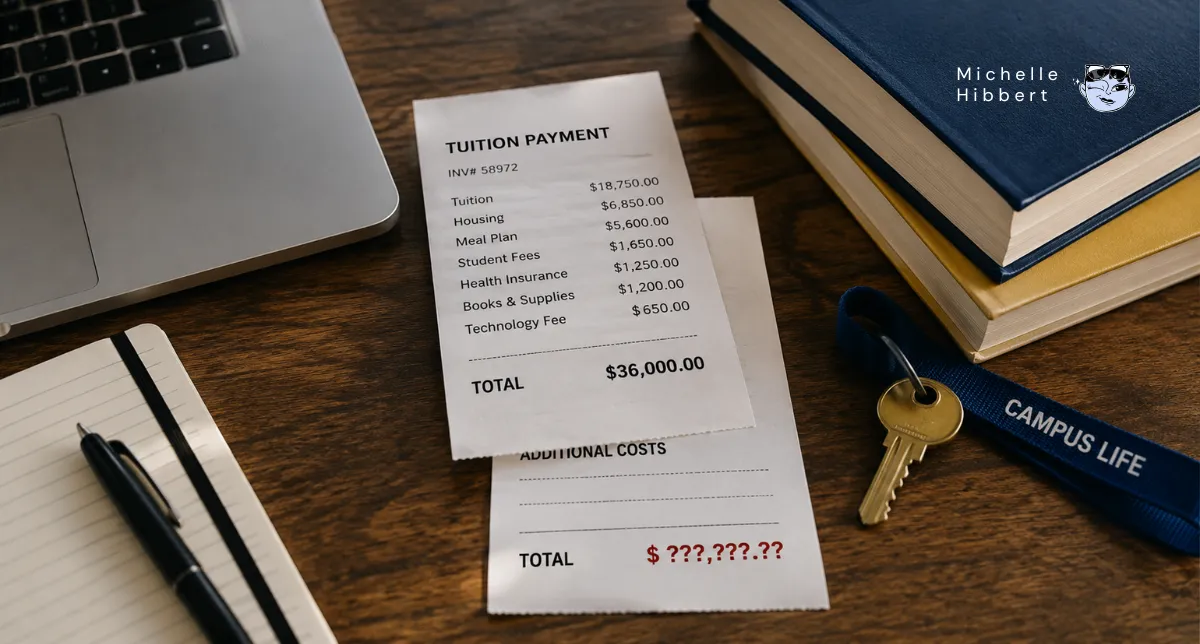
Nobody talks about the bill that comes after the bill
Prents…..let me ask you something that no one never thinks to ask.
Your son or daughter if they are heading to college- you've covered tuition, housing, a meal plan and probably a laptop right? You've thought about the big costs but did you budget the cost of getting to this point in time?
Not the academics as most kids are fine academically. But the rest of it. The decision-making, the emotional regulation, the knowing what they actually want and why. The ability to talk to a professor, manage a conflict with a roommate, handle a bank account that's running low, saying no to something that doesn't feel right.
Did you budget for that?
Nobody budgets for that. Not because parents are missing something but because our system spends far more time preparing young people for exams than for adulthood.
Here's what many families discover too late: when a young person doesn't have those skills, college doesn't go the way parents had planned. Semesters get muddled. Directions change. Sometimes the whole thing stalls and the family carries the cost of it, financially and emotionally, while trying to figure out what went wrong.
What went wrong was never the degree choice iIt was the gap underneath it.
The uncomfortable truth is this: one year of college can cost between $30,000 and $60,000 when you add it all up. A year off track, a mismatched major, a withdrawal and restart, a gap year with no structure, can cost the same. Sometimes more. Those costs are almost never accounted for upfront because families assume forward momentum means things are fine.
They are not always fine.
But here's the comparison nobody makes. A full programme of one-to-one coaching for a young person, the kind that actually builds the skills they need, the clarity about direction, the confidence to make decisions, the practical tools for real life costs a fraction of one semester. Not one year. One semester.
Unlike a semester, they sit through it passively, coaching is the thing that changes how they move through every semester after it.
It's not a nice-to-have; it can be the foundational investment that makes the rest of it work.
I've worked with enough young adults between 18 and 28 to know what the uncoached version looks like. It's a 20-year-old who is technically enrolled but emotionally checked out. It's a 22-year-old with a degree they don't know what to do with. It's a 25-year-old who is still financially dependent not because they're incapable but because no one ever helped them build the bridge between who they are and how to move forward.
I've worked with enough of them after coaching to know what changes. Not the degree, not the situation. Them. The way they think about themselves, handle setbacks, make choices, ask for what they need. That's what compounds. That's what the return on investment of coaching actually looks like when you're honest about it.
So the question to parents is….. it isn't whether you can afford coaching, it is whether you can afford the alternative.
One is avoidance, the other is strategy.
If you're watching your young adult struggle to launch and you're not sure what the next step looks like, let's figure it out together. No pitch, no pressure. Just a conversation about where they are and what they actually need.
Book a discovery call. I'd love to talk.
Because getting into college is one thing, being ready for what comes next is something else entirely.
