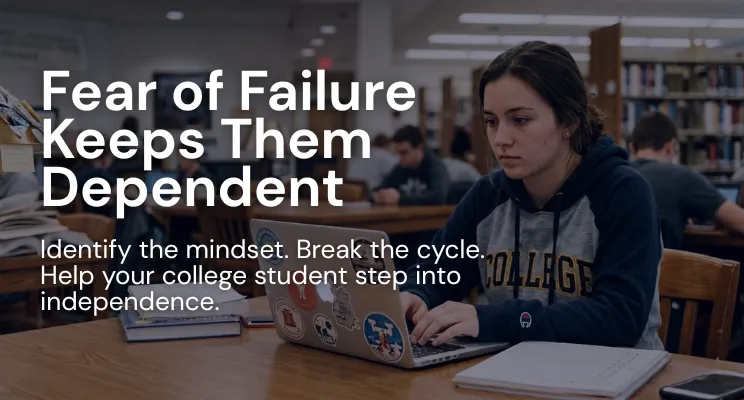
Why Your College Student Still Relies on You for Everything (And It's Not Laziness)
Let's start with something that might feel uncomfortably familiar.
Your son calls you three times before deciding which class to drop. Your daughter can't send an email to her professor without running the draft by you first. They're smart. They're capable. You know they are. But something keeps pulling them back to you, to the comfort of the familiar, to the safety net of "Mom, what should I do?"
And you're exhausted. And a little worried. And maybe even wondering if you somehow caused this.
Here's the truth: you probably didn't cause it but together, you can fix it.
What you're watching isn't laziness. It isn't immaturity (at least, not fully). What you're watching is fear of failure in action. And it is one of the most common, most invisible reasons college students struggle to become independent adults.
Let's talk about it.
What Is Fear of Failure, Really?
Fear of failure isn't just about being scared to mess up. It goes deeper than that.
For emerging adults, especially those between 18 and 25, fear of failure often shows up as:
Avoidance. They don't try things because if they don't try, they can't fail.
Overdependence. Letting parents (or someone else) make decisions removes the risk of being wrong.
Perfectionism paralysis. They'll do something but only when they're sure they'll do it right.
People-pleasing. They say yes, go along, and comply to avoid conflict or disappointment.
Psychologists call this atychiphobia in its more extreme form, but you don't need a clinical label to recognize it. You just need to notice the pattern: when things get uncertain, they freeze or they come running to you.
And here's the tricky part: the more you catch them, the less they believe they can catch themselves.
Why College Students Are Especially Vulnerable
The college years are supposed to be a launchpad. And for some students, they are. But for many others, they become a prolonged holding pattern, academically enrolled but emotionally still tethered to home.
Why? A few reasons:
The pressure is higher than ever. Today's college students are growing up with the weight of enormous expectations, academic performance, social media comparison, job market anxiety, student loans. Failure doesn't just feel bad. It feels catastrophic.
They've often been protected from failure. If you ran interference throughout high school communicating with teachers, solving schedule conflicts, smoothing over social situations your student may have never had to develop their own failure-recovery muscles. Not because you're a bad parent. Because you love them. But the unintended message was: "You can't handle this. I'll handle it for you."
Identity is still forming. Between 18 and 26, the brain's prefrontal cortex, the part responsible for risk assessment, planning, and long-term thinking is still developing. Combine that with identity exploration and you get a young adult who genuinely doesn't yet know who they are without external validation. Failure feels like proof of unworthiness, not a data point.
They've never been taught to fail forward. There's a difference between failing and learning from failure. Most academic systems reward right answers, not resilient recovery. If your student has never had someone model what it looks like to fail, dust off, and try again they'll treat failure as a dead end, not a teacher.
How to Identify the Mindset: 7 Signs Fear of Failure Is Running the Show
Before you can shift the mindset, you have to see it clearly. Here are the most common signs that fear of failure is what's keeping your emerging adult dependent:
They over-research but under-decide. They'll spend hours looking up options, comparing, asking opinions but somehow, a decision never gets made. This is not indecisiveness. This is avoidance dressed up as thoroughness.
They quit early or quit often. The class gets hard, the job gets uncomfortable, the friendship gets awkward and they're done. Fear of failure often looks like giving up before failing officially happens.
They need your reassurance constantly. Not occasionally, constantly. Before, during, and after decisions. Every. Single. Time. They are outsourcing their self-trust to you because they don't believe they have any of their own.
They catastrophize outcomes. "If I fail this exam, I'll fail the class, I'll lose my scholarship, I'll never get a job, my life will be ruined." Sound familiar? This all-or-nothing thinking is a hallmark of fear-driven behavior.
They avoid anything new. New clubs, new friendships, new opportunities passed up, deflected, or simply not noticed. When fear is running things, the comfort zone shrinks and the walls get higher.
They're highly self-critical after any mistake. Not just "that didn't go well." More like, "I'm so stupid. I always mess things up. I don't know why I even try." Harsh self-talk after setbacks is a big indicator that failure feels like an identity statement, not a temporary outcome.
They look to you as the authority on their own life. What career should I choose? Should I apologize to my roommate? Do you think I should change my major? These aren't casual questions, they're signs that they've handed the steering wheel of their life over to someone else. Probably to you.
The Mindset Shift: From Fear-Driven to Growth-Oriented
Here's the good news: mindset is not fixed. It can be shifted with the right tools, the right conversations, and the right kind of support.
This is exactly what coaching works on with emerging adults. And it's also what you, as a parent, can help reinforce at home.
Here's what the shift looks like in practice:
From "What if I fail?" → To "What will I learn?"
This is the foundation of a growth mindset (a term coined by Stanford psychologist Carol Dweck). When your student's inner narrative changes from "Failure means I'm not enough" to "Failure is feedback," everything changes. They start trying. They start recovering. They start building the one thing that fear has been eroding: self-confidence.
How you can help: Stop asking "Did you do well?" Start asking "What did you learn?" Celebrate the attempt, not just the outcome.
From "I can't do this without help" → To "Let me try and see"
Dependence is a habit. And like all habits, it gets broken through repetition of a new pattern.
That means your student needs to experience small wins on their own decisions they made, problems they solved, situations they navigated without calling you first.
How you can help: When they come to you with a problem, resist the urge to solve it. Instead, ask: "What do you think you should do?" Then listen. Then ask: "What's the worst that could realistically happen if that doesn't work out?" Then wait. You'll be surprised what they come up with when you stop filling the silence.
From "I have to do it perfectly" → To "Done is better than perfect"
Perfectionism is fear of failure wearing a very convincing disguise. It looks like high standards. But underneath? It's the terror of being judged, embarrassed, or wrong.
How you can help: Share your own imperfect moments genuinely, not performatively. When your student sees that you've made mistakes and lived to tell the tale (and even grown from them), they begin to believe they can too.
From "Failure defines me" → To "Failure informs me"
This is the deepest shift, and it takes time. It requires your student to start separating what they do from who they are. A failed exam is not a failed person. A dropped class is not a character flaw. A hard semester does not mean a hard life.
How you can help: Watch your language. "You failed" hits differently than "that didn't go the way you hoped." Words matter. Your narrative about their struggles becomes part of their internal narrative about themselves.
What Parents Can Do Right Now
You don't have to be a life coach to start making a difference. Here are five practical things you can do this week:
Have an honest conversation. Tell your student what you're noticing with love, not accusation. "I've noticed you seem to hold back from trying new things. I wonder if you're worried about what happens if it doesn't go perfectly. Can we talk about that?"
Create a safe-to-fail zone at home. Make sure your home environment communicates that mistakes are not disasters. How do you respond when they share a failure with you? With panic and problem-solving or with curiosity and steadiness?
Gradually pull back the safety net. Not all at once that's not helpful. But consciously, intentionally, start stepping back from decisions that are rightfully theirs to make. Let them book their own doctor's appointments. Let them email the professor themselves. Let them figure out how to get the refund on the flight they missed.
Encourage them to work with a coach. Sometimes the most powerful thing a parent can do is bring in a neutral third party, someone who isn't mom or dad, who can hold space for your student's growth without the weight of family history. A life coach who specializes in emerging adults can help your student do exactly this work: identify the fear, challenge the thought patterns, and start building real independence.
Take care of your own anxiety. Here's the thing no one says out loud: sometimes our kids stay dependent because we need them to. Our own fear of their failure, our own grief around them not needing us can keep the cycle going just as much as theirs does. This is not judgment. It's an invitation. Your growth is part of their growth.
If you've been carrying this, doing the extra calls, making the extra decisions, smoothing the extra path for years now, I want you to know something:
You did it out of love. And now, doing something different is also love.
Letting your emerging adult stumble, struggle, and figure it out isn't abandonment. It's belief. It's saying, with your actions, "I know you can do this."
Fear of failure doesn't get beaten with more protection. It gets beaten with practice, perspective, and the slow, steady accumulation of evidence that you survived the hard thing.
Your student can get there. They may just need a different kind of support to do it.
If you are a parent navigating this stage with your college student or emerging adult, this is exactly the kind of work we do, helping students build confidence, independence, and direction.
If this sounds like your family, reach out or book a discovery call. Independence doesn’t happen by accident. It’s built step by step.
Book a call here: Link
